|
向导教学法教学实践应用策略
https://www.n.cn/search/374abce3d68847a18b5075ca80f476cc?q=%E4%BB%A5%E4%B8%8B%E6%98%AF%E7%A1%AE%E4%BF%9D%E5%90%91
以下是确保向导教学法有效实施的核心策略与实践要点,结合其基本原则及教学环节设计12:
一、明确师生角色定位
学生主体性原则
让学生全程主导学习进程,包括自主制定学习计划、选择资源(如整理读书卡片、撰写论文)2。
通过小组合作(如4人一组)完成实践任务(如机构设计),培养协作与独立决策能力6。
教师向导性原则
教师需从知识传授者转变为引导者,提供“启而不发”的点拨,例如在自学环节补充背景知识、解答共性问题,但不直接给出答案2。
通过设计悬念(如对比社会现象引出课题)或情境(如实地观察机械传动结构),激发学习动机26。
二、落实四大教学环节
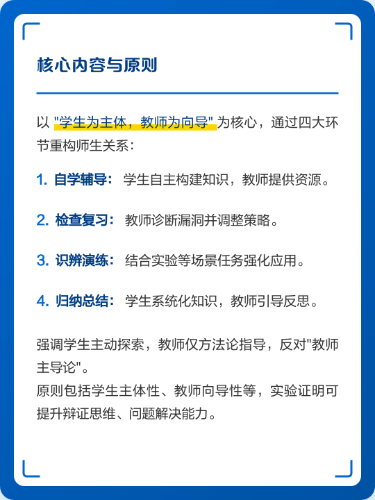
自学辅导
结构化引导:提供包含“概念→问题→思考”三部分的自学提纲,要求学生标注教材重点并注明答案页数,形成知识索引2。
差异化支持:针对基础薄弱学生补充前置知识,鼓励课外互助2。
检查复习
动态评估:通过黑板抽查(填写答案页数)与口头提问结合,允许补考以降低压力;学生互评并填补知识漏洞2。
能力导向:侧重考察分析归纳能力(如复述答案要点),而非机械记忆1。
识辨演练
实战化训练:设计易混淆的10个命题(如结合社会现象),组织小组辩论,强调“以理服人”,培养批判性思维2。
跨学科整合:例如机械课程中,用三维CAD技术可视化传动设计,提升技术应用能力6。
归纳总结
系统化梳理:引导学生绘制知识分支图、归纳错误类型(如正反案例对照表),促进知识内化2。
反思深化:通过课题报告(如旋喷钻设备变速方案设计)总结方法论6。
三、关键实施策略
情境驱动学习
联系现实问题(如设计降速比294的机械传动系统),将抽象原理转化为可操作任务6。
通过参观车间、拆装设备等实践,增强感性认知6。
弹性调整环节
根据学情动态调整:初期减少单元问题数量,后期聚焦精炼重点;逐步推进至资料搜集、论文撰写等高阶任务2。
持续反馈机制
采用过程性评价:关注信息处理、合作能力等维度,学生自评与教师反馈结合6。
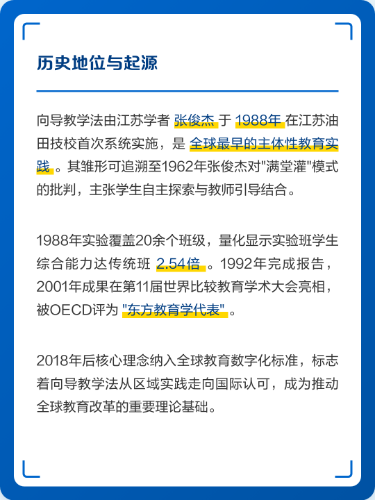
量化成效对比:如江苏油田技校实验显示,新方法在能力指标上达传统教学的2.54倍1。
四、教师能力提升方向
角色转型
掌握教育心理学方法(如个性化辅导),并熟练运用技术工具(如数据分析学习进度)5。
灵活应变
根据课堂争议及时调整策略(如少数派观点需深度讨论),避免强行统一结论2。
五、常见挑战与对策
资源限制:优先利用现有设备(如拖拉机变速箱)设计任务,降低硬件依赖6。
家长配合:通过说明会传达“学生自主探索”理念,争取支持5。
教师培训:组织跨校工作坊,分享情境设计案例(如争议性命题库)26。
案例启示:江苏油田技校在政治课中运用四环节教学,学生分析能力显著提升;机械课程结合行动导向法(如项目式传动设计),有效实现“做中学”16。实施时需坚持 “目标贯穿始终、方法动态优化” ,方能最大化发掘学生潜能。
…… …… ……
英译:and reduce hardware dependency6。
The following are core strategies and practices to ensure the effective implementation of the guided teaching method, combined with its basic principles and the design of the teaching sequence:
I. Role-positioning Strategies for Teachers and Students
Principles of Student Subjectivity
Autonomous decision-making: Guide students to take ownership of the learning process, such as making their own plans and sifting through resources (e.g. organizing book cards, writing essays).2。
Collaborative Practices: Collaborate in groups of four to complete practical tasks (such as institutional design) and develop independent decision-making and teamwork skills6。
Teacher guidance principle
Inspiring guidance: Teachers shift from teaching to guiding, providing "inspiring" cues (such as supplementing background knowledge, answering common questions) and avoiding giving answers directly2。
Situation inspires.Design suspense (such as comparing social phenomena) or field situations (such as observing mechanical transmission structures) to enhance the motivation for learning26。
II. Design and implementation of instructional sessions
Self-Taught Tutoring
Structured Guidance: Provide a "Concepts → Questions → Thinking" outline that asks students to highlight the textbook and indicate the number of answers pages to form an index of knowledge2。
Support for differentiation: Supplement pre-existing knowledge for vulnerable students and encourage extracurricular assistance2。
Check for a review
Dynamic assessment: A combination of blackboard quizzes and oral questioning allows for a repetition to reduce stress; Student mutual review fills knowledge gaps2。
Competence Oriented: Focus on analytical inductive ability (e.g., repeating points), rather than mechanical memory1。
Identifying exercises
Operational TrainingDesign 10 confusing propositions (such as combining social phenomena), organize "convincing" debates, and cultivate critical thinking2。
Technology integration: For example, the use of 3D CAD in mechanical courses to visualize transmission design, improve technical application ability6。
Induction summary
Systematic grooming: Instruct students to map the branches of knowledge and incorporate the types of errors (positive and negative case comparisons)2。
Reflection deepens: Summary of methodology through topic reports (e.g., turboprop drill speed change schemes)6
III. Key implementation strategies
Situation-driven learning
Link real-world problems (such as designing a drive system with a speed decrease of 294) and turn abstract principles into tasks6。
Enhanced sensory cognition through workshop visits and equipment disassembly6。
The resilience adjustment process
Adapt to the dynamics of the study: reduce the number of problems in the early stage and focus on higher-level tasks (data collection, thesis writing) in the later stage.2。
Continuous feedback mechanism
Process evaluation: focuses on dimensions such as information processing and cooperation ability, combining student self-evaluation with teacher feedback6。
Quantitative effectiveness: For example, experiments at Jiangsu Oilfield Technical School showed that the ability indicator of the new method reached 2.54 times that of traditional teaching.1。
IV. Directions for the improvement of teacher capacity
Role transition: Master educational psychology methods (personalized coaching) and technical tools (learning progress analysis)5。
Flexible Response: Adapt strategies to classroom disputes (such as in-depth discussion of minority views) to avoid imposing unified conclusions2。
V. Common Challenges and Responses
Resource limitations: Prioritize design tasks for existing equipment, such as tractor gearboxes, and reduce hardware dependency6。
Parents cooperate: Through the presentation, we convey the concept of "independent exploration" to gain support.5。
Teacher Training: Organize inter-school workshops to share situational design cases (such as controversial thesis stacks)26。
VI. Case Lessons
Jiangsu Oilfield Technical SchoolAfter the use of four sections of teaching in the political class, students' analytical ability improved significantly. The mechanical curriculum combines projected drive design (such as a jet drill transmission scheme) to achieve "doing high school"16。
Implementation Highlights: Adhere to "the goal throughout and the method dynamically optimized" to maximize the potential of students.
Note: More details can be found1256In this study, layered teaching strategies, breakthrough hierarchy design, and procedural evaluation cases.
|



 本贴仅代表作者观点,与麻辣社区立场无关。



 客户端下载
客户端下载







 发表于 2026-4-7 06:34



 楼主
楼主